
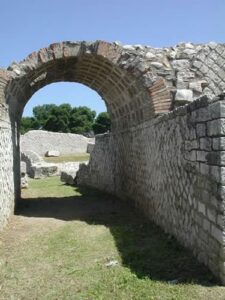
This is where Roman Venosa can be read on the ground. Venusia was founded as a Latin colony in 291 BC and became one of the main towns along the Appian Way: a walk through the park covers more than a thousand years of history, from the Republic to the Middle Ages.
What to see
- The bath complex, built in the 1st century AD and altered until the early 4th century.
- A house decorated with mosaics and a block of the ancient town bounded by two stone-paved streets.
- The so-called early Christian baptistery (late 5th – early 6th century), built over buildings of the imperial age.
- The unfinished church («Incompiuta») of the Holy Trinity Abbey.
- A little further on, across the road, the Roman amphitheatre.
Visiting tips
- The unfinished church lies inside the park and is included in the same ticket: many visitors mistakenly think they are two separate entrances.
- On Tuesdays the park closes at 13:45 (last admission 13:00): plan your visit on another day if you can.
- Download the free Venusia Maps Experience app for interactive maps and audio.
- Works are under way to remove architectural barriers: there is an entrance ramp, benches along the route, a wheelchair on request and a tactile panel at the entrance; accessible toilets are temporarily replaced by portable ones.
Contacts
Opening hours
Every day from 9:00 until one hour before sunset; on Tuesdays 9:00-13:45 (last admission 13:00). Closed on 25 December and 1 January. €5 full, €2 reduced, free under 18 and on the first Sunday of the month. Combined ticket with the Museum €8, valid for 3 days.